
Views: 0 Author: Site Editor Publish Time: 2026-06-15 Origin: Site


Mechanical engineers, procurement managers, and product designers constantly evaluate material specifications for highly stressed components. Finding an optimal, reliable metal poses a persistent engineering challenge. You must bridge the gap between competing material properties. Mild steel offers excellent ductility and easy forming. However, it lacks the raw strength needed for dynamic loads. Conversely, high-carbon variants deliver immense yield strength. Unfortunately, they suffer from severe brittleness and demanding machining requirements. medium carbon steel solves this precise dilemma. It provides the optimal balance of tensile strength, wear resistance, and machinability. You can unlock these properties easily, provided you apply the correct grade and heat treatment protocols. In this comprehensive guide, we explore the distinct metallurgical profile of this versatile material. You will learn about its ideal use cases, critical trade-offs, and processing requirements. We also compare top industry grades to streamline your upcoming material procurement decisions.
Defining Composition: Contains a carbon mass fraction between 0.30% and 0.60%, supplemented by manganese (0.60%–1.65%) for enhanced hardenability.
Optimal Use Cases: the standard choice for forged structural parts, automotive drivetrains, axles, and heavy-duty gears.
Critical Trade-offs: Achieves superior mechanical properties only after proper heat treatment (quenching and tempering); requires stricter welding controls compared to low-carbon alternatives.
Top Procurement Grades: Industry standards are dominated by SAE1045 Medium Carbon Steel and C45E+N Engineering Steel.
The chemical composition of an alloy dictates its final microstructure. The defining characteristic here is a strict carbon mass fraction. This value sits precisely between 0.30% and 0.60%. This specific metallurgical range creates an ideal balance of ferrite and pearlite within the metal.
Ferrite represents the pure, softer phase of iron. It brings essential ductility and malleability to the matrix. Pearlite consists of alternating layers of ferrite and cementite. It introduces necessary hardness and yield strength. By maintaining this delicate balance, engineers achieve a versatile material profile. You can machine the material relatively easily in its raw state. You can also harden it significantly through controlled thermal processing.
This material exhibits drastically different properties depending on its thermal state. Procurement teams must understand these variations to specify the correct delivery condition.
Performance Metric | Untreated (As-Rolled) State | Heat-Treated (Quenched & Tempered) |
|---|---|---|
Yield Strength | Moderate (Sufficient for static loads) | Exceptionally High (Ideal for dynamic stress) |
Machinability | Excellent (Yields predictable tool wear) | Reduced (Requires specialized carbide tooling) |
Surface Hardness | Low to Moderate | Extremely High (Highly wear-resistant) |
Core Toughness | High (Easily absorbs impact) | Retained (If tempered correctly) |
Why do engineering teams specify this exact material profile? The answer lies in component survivability. Impact resistance and fatigue strength serve as non-negotiable success criteria for moving mechanical parts. A shaft spinning at high RPMs experiences constant cyclical loading. A brittle material will eventually shatter under these conditions. A soft material will deform or wear away quickly. This specific alloy absorbs energy efficiently while resisting surface degradation.
Understanding where to deploy this material prevents catastrophic mechanical failures. Different industries leverage its unique blend of toughness and strength for highly critical applications.
The automotive industry relies heavily on this metal category. Typical parts include engine crankshafts, drive axles, transmission gears, and coupling components. These parts face immense rotational stress and friction.
The selection logic remains straightforward. High rotational stress requires a part possessing a tough, flexible core. Simultaneously, the part needs a highly wear-resistant exterior. Manufacturers achieve this specific dual-profile using induction hardening. They heat the outer surface rapidly using electromagnetic fields. They quench it immediately to lock in the hardness. The core remains unheated and ductile. This prevents the gear teeth from snapping off during sudden torque spikes.
Heavy machinery operates in punishing environments. Engineers select this alloy for forged connecting rods, heavy railway wheels, and hydraulic machinery shafts. These components endure extreme physical demands daily.
These applications demand high-cycle fatigue resistance. The material undergoes millions of stress cycles during its operational life. It can withstand this constant bending and compressing without succumbing to catastrophic brittle failure. When engineered correctly, microscopic cracks struggle to propagate through the balanced ferrite-pearlite microstructure.
Construction and heavy assembly require robust fastening solutions. Manufacturers use this material for high-strength bolts, anchoring studs, and heavy-duty structural clamps.
Structural hardware must maintain integrity under severe shear and tensile loads. Mild steel bolts stretch and snap under similar forces. High-alloy bolts provide adequate strength but cost significantly more. This material provides the necessary holding power. It remains economically viable for massive bulk manufacturing runs.
Selecting the correct base metal requires comparing adjacent categories. Carbon Steel falls into three primary classifications based purely on carbon concentration. Each grade serves a distinct industrial purpose.
Material Classification | Ideal Applications | Primary Limitations |
|---|---|---|
Low Carbon (Mild) Steel | High-volume forming, deep drawing, extensive welding. | Insufficient yield strength and poor wear resistance for moving parts. |
Medium Carbon Steel | Machined components requiring balanced toughness and strength. | Requires strict thermal processing and careful welding controls. |
High Carbon Steel | Cutting tools, industrial springs, high-wear blades. | Too brittle for impact applications; extremely difficult to machine. |
Low Carbon (Mild) Steel: This grade shines in fabrication shops. You can bend, stamp, and weld it effortlessly. However, it fails in power transmission applications. It simply lacks the yield strength to handle dynamic mechanical forces.
Medium Carbon Steel: This grade represents the manufacturing sweet spot. It costs slightly more to process than mild steel. However, it costs significantly less than complex high-alloy alternatives. It provides the exact mechanical properties needed for heavily machined, load-bearing components.
High Carbon Steel: This grade delivers incredible hardness. Engineers use it for cutting edges and tensioned springs. Unfortunately, it fails in structural applications. Impact forces cause brittle fractures. Furthermore, machining this grade wears down expensive tooling rapidly.
Global material standards define specific alloy compositions. Procurement teams generally focus on two dominant industry specifications when sourcing this material.
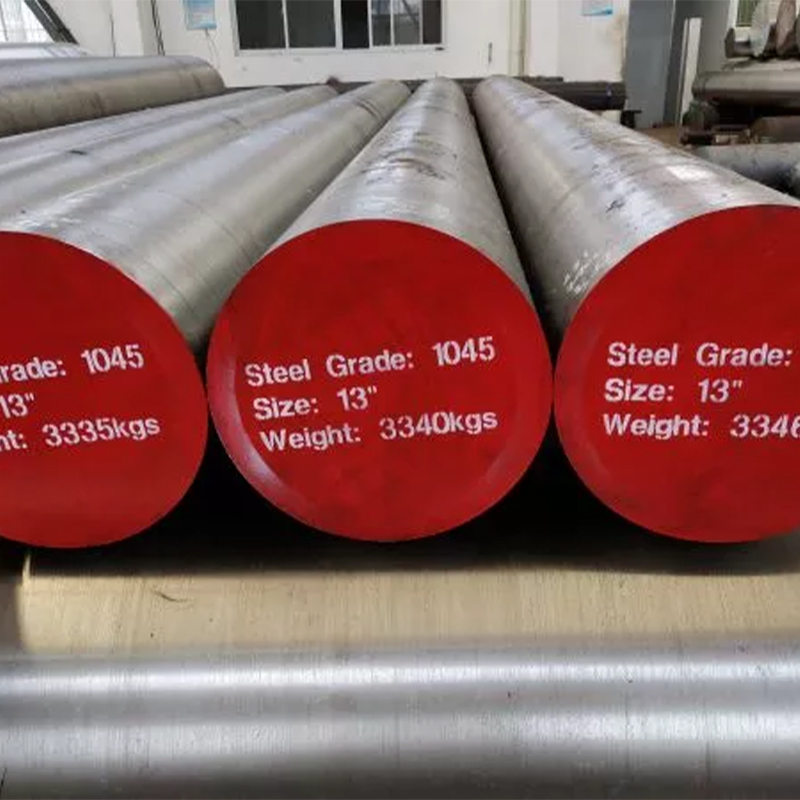
We often specify SAE1045 Medium Carbon Steel for North American manufacturing projects. This grade contains approximately 0.45% carbon. It features incredibly high market availability across various stock shapes.
Its procurement value is unmatched. Engineers consider it the ubiquitous baseline for manufacturing shafts, axles, and gears. Machining costs remain highly predictable. Furthermore, the alloy responds exceptionally well to standard quenching and tempering treatments. You can achieve consistent, repeatable mechanical properties across large production runs.
European specifications rely heavily on C45E+N Engineering Steel. This grade acts as the European equivalent to the 1045 standard. Suppliers explicitly provide it in the normalized (+N) condition.
The normalizing process adds immense procurement value. Normalizing ensures a highly uniform, fine-grained microstructure throughout the entire metal block. This refined structure drastically reduces internal residual stresses. Consequently, the material exhibits superior dimensional stability during aggressive CNC machining. Parts resist warping and twisting when you remove large volumes of metal.
Material verification prevents costly manufacturing failures. You must demand Mill Test Reports (MTRs) from your material supplier before issuing any purchase order.
Best Practice: Always cross-reference the heat number stamped on your physical steel stock against the provided MTR. The MTR verifies the exact chemical composition. It confirms that the mechanical properties meet your engineering requirements. Never process undocumented metal for critical load-bearing applications.
Processing this material requires specific shop floor strategies. You cannot treat it like standard mild steel. Ignoring these operational realities leads to broken tools, cracked welds, and distorted parts.
Machining requires careful planning. This alloy generally rates around 55% to 60% machinability when compared to baseline free-machining steels. It produces distinct chips and generates substantial cutting heat.
Risk Mitigation: You should utilize normalized stock whenever possible. The uniform grain structure of normalized metal cuts much more cleanly. This simple choice prolongs your expensive cutting tool life. It also prevents unexpected part warping during aggressive material removal operations. Operators should employ coated carbide inserts and optimize coolant delivery to manage the cutting zone temperatures.
Welding introduces significant metallurgical complexity. You must trust experienced welders when joining this material. Unlike mild steel, the higher carbon equivalent (CE) introduces severe risks.
The primary danger is hydrogen-induced cold cracking (HICC). Hydrogen gas from the welding environment dissolves into the molten metal. As the weld cools rapidly, the hydrogen becomes trapped inside the hardened microstructure. This creates immense internal pressure, eventually tearing the metal apart from the inside.
Required Welding Procedures:
Implement mandatory pre-heating protocols. You must heat the base metal between 300°F and 500°F before striking an arc.
Maintain consistent interpass temperatures throughout the entire welding process.
Utilize low-hydrogen welding electrodes exclusively.
Apply controlled post-weld stress relief (PWSR) to temper the heat-affected zone and prevent delayed cracking.
Heat treating upgrades the mechanical properties but introduces physical risks. Water or oil quenching causes severe thermal shock. You must acknowledge the distinct risk of part distortion during the hardening phase.
Common Mistake: Machining a precision component to its absolute final dimensional tolerances before sending it to the heat treater. The part will likely warp slightly, ruining the tight tolerances.
Best Practice: Always leave grinding allowances on any tight-tolerance dimensions prior to hardening. Hardening inherently alters physical dimensions. Performing a final cylindrical or surface grinding operation after heat treatment ensures perfect final specifications.
Material selection defines the ultimate success of your mechanical assemblies. This versatile alloy provides a powerful engineering solution for demanding environments. It remains the pragmatic, cost-efficient choice for dynamic, load-bearing parts. Mild steel proves too weak for these forces. High-carbon variants prove too brittle and difficult to machine. By balancing toughness, machinability, and yield strength, this material secures its place in modern manufacturing.
Take the following action-oriented steps to optimize your next project:
Review your engineering load calculations to confirm exact fatigue and tensile requirements.
Consult directly with a qualified metallurgist or materials supplier. They will help you finalize the optimal delivery condition, choosing between as-rolled, cold-drawn, or normalized stock.
Specify your heat treatment requirements clearly on your manufacturing drawings to avoid distortion issues.
Request a detailed material quote and download the corresponding technical data sheets to verify grade-specific availability.
A: Yes, it responds exceptionally well to traditional heat treatment. You can drastically increase its strength through quenching and tempering. It also readily accepts surface hardening techniques, such as induction hardening and flame hardening, to create a wear-resistant exterior while maintaining a tough core.
A: Yes. Like all standard carbon steels, it contains a high concentration of iron. The ferrite phase within its microstructure makes the material strongly ferromagnetic, allowing it to interact effectively with industrial lifting magnets and electromagnetic sensors.
A: Yes. It entirely lacks the protective chromium content found in stainless steel alloys. Consequently, it oxidizes rapidly when exposed to moisture and oxygen. You must apply protective coatings, routine oiling, or specialized plating to ensure adequate long-term corrosion resistance.
A: The difference lies primarily in the carbon percentage. Grade 1040 contains roughly 0.40% carbon, offering slightly better ductility and easier machining. Grade 1045 contains roughly 0.45% carbon, providing marginally higher tensile strength and a stronger response to heat treatment for precision procurement.


